Some of the best projects stem from real frustrations. I’ve personally struggled with creating small GIFs for project documentation on Wayland - no existing solution worked well. My workaround? Screen record with OBS, manually convert with ffmpeg. Time-consuming, janky, and frustrating.
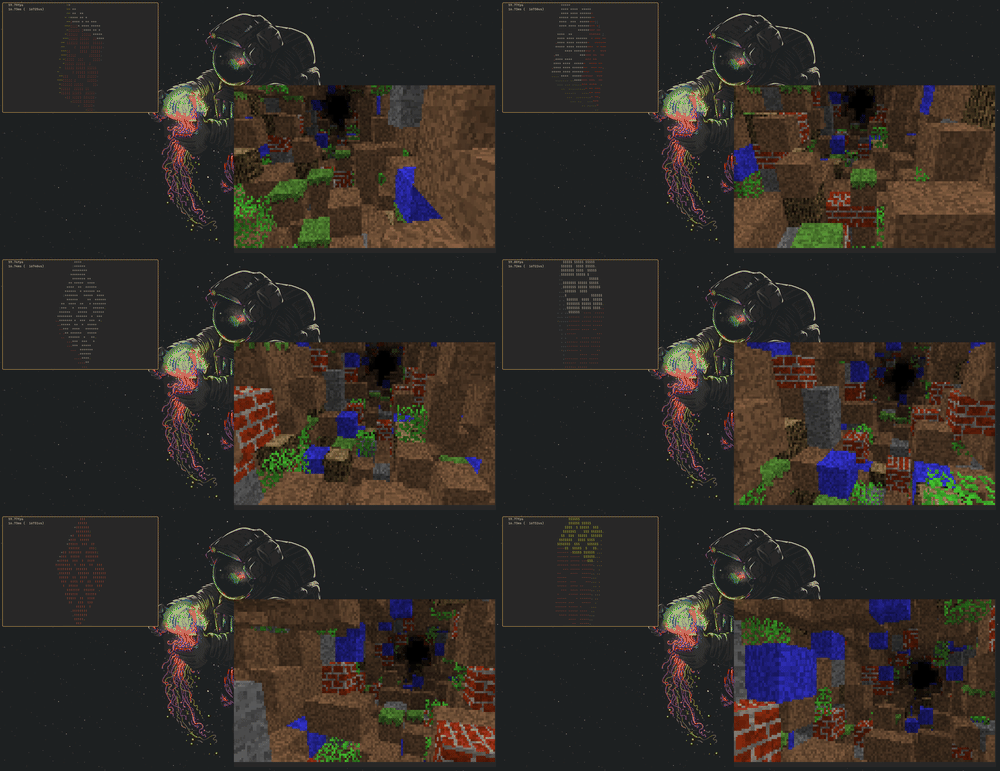 wlgif demo showcasing rs-cube and minecraft_tunnel
So I built wlgif - a lightweight screen recorder for Wayland that captures regions as GIFs. What used to take several minutes now takes less than 10 seconds.
GitHub: https://github.com/doprz/wlgif
Stats: ~1000 lines of Rust code, 99KiB repository size, with scc estimating $38k development cost.
The problem:
Screen-to-GIF on Wayland has been surprisingly painful. Most tools only work on specific compositors, forcing users into awkward workarounds. wlgif solves this with a dual-backend architecture that works on ANY Wayland compositor - whether you’re running GNOME, KDE, Sway, Hyprland, or anything else.
Technical architecture:
The dual-backend system provides universal Wayland compatibility:
XDG Desktop Portal backend (universal):
- Portal request via D-Bus for compositor screen access
- Compositor’s native picker for source selection
- PipeWire captures video stream from compositor
- GStreamer encodes stream to MP4
wlroots backend (optimized for wlr-based compositors):
- slurp for interactive region selection
- wf-recorder captures via wlroots screencopy protocol
Backend abstraction → GIF conversion:
- ffmpeg analyzes video to generate optimal 256-color palette
- ffmpeg applies Floyd-Steinberg dithering for final encoding
This two-pass encoding produces significantly smaller, better-looking GIFs than naive single-pass conversion.
Development infrastructure:
Built in Rust with first-class Nix support. The real breakthrough: I reverse-engineered Ghostty’s NixOS VM approach to create declarative, reproducible integration test environments using QEMU - true infrastructure as code.
A single Nix command spins up a VM with the new wlgif derivation, automatically configures SPICE connection, sets up VM tools, and connects via virt-viewer. Code on host, test specific backends in VMs that rebuild with the updated wlgif binary. Thanks to Nix’s derivation system, only the changed components need to be rebuilt - the entire test environment is declarative and reproducible.
Big thanks to the Ghostty project for the VM testing inspiration and nix.dev for excellent NixOS VM documentation.
#Rust #Wayland #Linux #OpenSource #Nix #NixOS #DevOps #IntegrationTesting